Tuesday, March 12, 2013

Cold Turkey


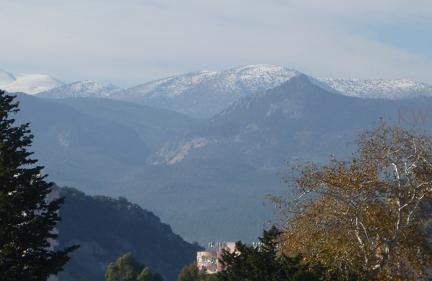
High in the Taurus Mountains is a veiled treasure, an astounding location where dreams and reality collide in a brilliant display of winter sunshine. Following the bumpy single lane road for 50 kilometres through the densely forested foothills where boar and stags rove freely to the top of the highest peak in the area was as challenging as it was rewarding.


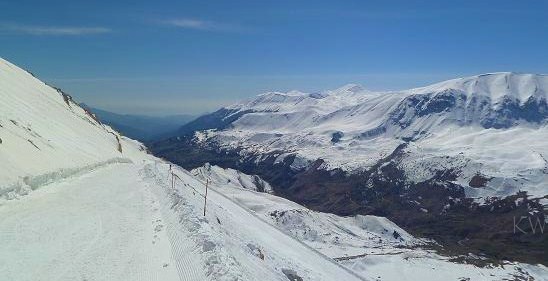
The early spring thaw hadn’t yet begun in earnest, so although the approach was clear of ice and mud the mountains were still deep with packed snow. They glistened in the crystalline air with the glaring clarity of Technicolor against a black and white backdrop.

We headed out early on a midweek morning, expecting to be on top of the mountain enjoying lunch after a brisk hike to the observatory on the peak. With its Russian built telescope and pollution-free viewing position the platform is ideal for indulging in scene gazing, and promises a breath-taking spectacle. Neither the vista nor the food at the restaurant disappointed, though there were the usual farcical incidents thrown in we had a great stay on the summit.

The rugged peaks of the 'Toros' mountain chain run the entire breadth of Turkey’s southern coastal border, from the Mediterranean to the edge of the Tigris and Euphrates rivers where they meet the steppes of Asia.

Dotted amongst the high jagged peaks are many fashionable resorts with an endless diversity of wonderland scenery. As more of the slopes in Western Europe become crowded with tourists, people are discovering the southern region of Turkey is about more than fabulous beaches, ancient temples, nightclubs, amazing scenery and fresh local produce, there are also spectacular winter sports areas.

Named ‘hidden town’, the charming resort we chose to visit, nestled in an isolated spot deep in the majestic landscape of this scenic snow-capped region, is one of many areas throughout the country gaining renown as exciting alternatives to the crowded Alpine trails. At over 2400 metres, or almost 8000 feet, the end of the line for the chairlift is still more than 1200 metres below the highest of the mountains in the range.


Though I’m not keen on exposed heights, I didn’t want the ladies to lose their nerve either, so I suggested they ride together while I went solo down the steep slope. It only takes five and a half minutes, but the 745-metre cable is suspended above a treacherous looking valley and looks across to the distant glacial ridge, which allows for the sensation of a longer trip.

As the chair swings out beyond the edge of the cliff and one is left dangling high above the crest of the mountain that vertiginous sensation takes the breath away and the suspension of disbelief is shattered, however, it also gave me the opportunity for some great photos.

The pristine water of this mountain reservoir halfway down the slope is where my home drinking water is bottled, its source being the streams that direct the melting snow from the neighbouring mountains of course. The perfect spot for a picnic on a spring day, this emerald lake is situated off the beaten path amongst the woodland pines. Above and beyond its own natural beauty the location also offers a panoramic view of Antalya spread out like a magic carpet around the bay at the base of the mountains.


Like giant Lego shapes or a child’s building blocks, these mountains have been chiselled and chopped into massive slabs of pure marble used for housing materials. The size is extraordinary and it’s difficult to grasp the scale without realising that those tiny little figures in the distance are actually huge bulldozers and dump trucks that would dwarf most usual lorries.

One of my Turkish friends said she thought the quarry was ugly and an eyesore in the natural landscape of this otherwise unspoilt terrain. Marble is a rock with specific mineral qualities and is in great demand locally and abroad for it’s beauty as well as functional properties, and this rock mine will undoubtedly provide many jobs which are extremely important to the manufacturing industry.

Weighing the environmental damage against the economic necessity and maintenance of a decent standard of living becomes a balancing act that requires negotiation and compromise. Although it isn't pretty to see such incredible natural formations destroyed, with so many mountains available and so much need for housing in the area it becomes an understandable necessity to create substantial foundations for the growing population of this region, and it does provide a way to incorporate environmentally harmonious material into the architectural design of the region.


A few days earlier there had been a theme party at one of the café nightclubs near the aquarium, and the local crowd turned out in hippie garb to get into the spirit of the age. A couple of Turkish film stars turned up for a photo session (though admittedly they were in formal attire and had popped out of the Latin dance club across the small lake) and everybody wanted in on the act. We even hit the local gazette in full psychedelic splendour as the paparazzi clamoured around snapping at the hippy version of a red carpet. With a live band doing their best to replicate the feel of those lost heady days, a special reduced price on drinks for our group, and a contest for best-dressed hippy, the party lasted long into the night.

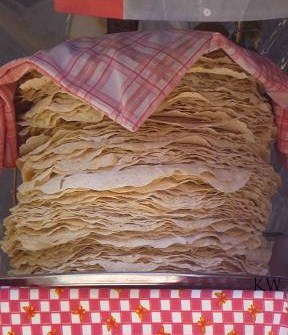
Sundays there is a notable regional market in an otherwise sleepy village in the foothills. We went for a stroll and breakfast in a tree house a few weeks ago and enjoyed pomegranate juice and some of the best flat breads I’ve ever eaten. Tortilla style wraps were filled with pretty much anything you wanted, you only had to ask and it was all brought out from the massive open air griddles to your chosen tree house, of which there were many dozens scattered throughout the woods. I opted for a traditional style breakfast at the suggestion of my hosts, which included pizza-dough thick wraps with eggs, cheese, meats and vegetables cooked into them, salads and a selection of sauces, and of course plenty of sweet black tea.


Thanks to the supportive turnout of the community it was another great night in the old town when we headed out for Billy’s speak your mind comedy and poetry gig a couple Saturdays ago. I threw together a short set after the hysterically outspoken Scot had done his thing and local mountain guide Turkeman told a harrowing tale of avalanches, then we all went dancing to live rock music in a traditional Ottoman building near the marina.
I met a friend for lunch one afternoon near the famously steep and slippery 40 steps that run alongside the ancient city walls, and was surprised to discover this remarkable and somewhat concealed marina was nearly as busy with tour boats in March as I’d seen them mid-summer.

We enjoyed a leisurely walk around the cobbled passageways and alleys of the old town and after a couple glasses of a fine regional wine decided to take the longer but less steep route back past the old clock tower through the central pedestrianised shopping district.

Overall, winter hasn’t been too bad here; with temperatures ranging from 12 to 24 degrees (the 50s-70s Fahrenheit), and only occasional brief flooding of the roads around the city as the tremendous storms lash the coast from the sinister clouds that gather as thick disapproving eyebrows over the mountaintops. Most days the sun has shone and the cafes were doing a steady trade while at night the torrential rain would batter the city accompanied by the rumbling peals of thunder and flashes of frightening bolt lightning that illuminated the craggy peaks of the Taurus Mountains.


As you probably know from previous posts, my upstairs terrace looks out over the nearest of the weather-beaten and wrinkled mountains, and they almost cast a shadow across this protective basin. As the sun descends beneath behind their rocky tops on a winter day and casts beams of kaleidoscopic light across the valley the evening cool settles as the snow on the jagged pinnacles.


A great place to live and work, this city and its inhabitants are among the nicest anywhere in the world – with the Mediterranean climate and the facilities of every large city right on the doorstep, why would I be anywhere else?

I hope your winter has been as fruitful and interesting as mine, with events and courses, visits to scenic and fascinating locations, nights with good friends and days out with some wonderful people.

Although season has been chilly, it certainly hasn’t been nearly as unpleasantly cold as other places I’ve lived, and has been as mild as can be expected in northern latitudes, giving me another reason not to quit cold turkey.

But, the world is ever-changing, and sometimes opportunities come along that demand attention; often we have to take a chance and delve into the unknown of the future with ambition in order to uncover our capabilities.


Turkey has become a friend, a lover, a compatriot and guardian, however new treasures and discoveries await and only time will reveal knowledge of what destiny keeps hidden.

I'm simply grateful for the fresh water and food I eat, the friends who keep me company and the many wonders I've seen. The natural world is my home not a place to be conquered - it belongs to us all and we must do what we can to heal and not harm.

The fresh water we drink comes from the springs beneath the earth that rise up to form lakes, the air that we breathe needs a healthy filtration system too and that requires forests and jungles, and the ground where we grow our food, it too needs minerals to keep it healthy, just as we do.


All of life is connected, and all of life is contrary, let's work for that healthy homeostasis in nature. Both the organic and the social must be in balance and as spirits in this material world we must guard the only means of life that we have to ensure its lasting health and beauty.

So, as springtime colours the world and blue skies and sunshine push the threatening clouds away again till the end of the year, I will be dreaming of the future and living for the present – the gift of living on the only planet we have. Let’s take care of it and remember Earth is the source of everything we need to live.

*     *     *

Tuesday, January 01, 2013

Noel Baba .. Happy New Year!

I’ve been asked by a few people why I haven’t written a festive Blog this year, so I thought I’d better grab an hour from the busy day to put a few words down and upload some photos. Initially, I was going to write about how ‘Father Christmas’ or Santa Claus, got his name brand recognition, why people all over the world know his name and general character in one form or other and follow the custom of giving gifts at this time of year. But if you want to know about all that you can easily Google it. So, instead I’ll just let you know what Christmassy type things I’ve been up to lately.


There have been parties and gatherings galore over this festive period, and I received so many invites I couldn’t possibly have attended everything. Fortunately, I have some wonderful friends who insisted on coming round to ensure I didn’t have a lonely Christmas night.
 
 
I quickly tossed some shrimp on the barbie, with Cajun seasoning and grilled veggies, a massive portion of my special nachos (is this a traditional Christmas dinner? one Turkish friend asked, to much bemused laughter) and melt-in-the-middle chocolate puddings with hot cherries and sauce, accompanied by Baileys and other assorted tasty festive treats.
 
 
After the hectic weeks leading up to the celebrations I could do with a rest and a few days just chilling, but New Years Eve on the beach after the party in a fabulous restaurant in the heart of the Old Town of Kaleici was simply amazing.
 
A few days ago I attended a friends birthday lunch in Lara after returning from the airport to collect my wife, who was off on yet another whirlwind holiday trip abroad. I spent several days running around shopping malls this past week (anyone who knows me knows I really don’t like these massive consumer palaces), while entertaining, visiting friends, going to late night parties (nothing starts before about 10pm here) and completing my class schedule – no time off for Christmas in Turkey, so thank goodness for two days off at New Year.
 
How did all this mayhem and magic begin one often hears people say, so I’ve included a little sample of the stories behind the man we call Saint Nick.

 
Nicholas was born over 1500 years ago in the town of Patara, near Antalya, along the now Turkish Mediterranean coast. His father died when he was young, leaving Nicholas a vast fortune. Instead of spending it on himself, Nicholas started anonymously donating the money to the poor, especially needy children. He rose through the Byzantine ranks of the Church to become the Bishop of Myra (modern-day Demre in Turkey), where he is credited with performing several miracles, including saving sailors from drowning and resurrecting three boys who had been killed by an evil butcher. Today, St. Nicholas is the patron saint of children, sailors, teachers, students and merchants.
The most famous anecdotal fable of Saint Nicholas concerns a poor man (often said to be a nobleman fallen on hard times) who had three daughters. The daughters had no chance of marriage, since their father could not pay for a dowry. One night Nicholas left a sack of gold on the doorstep of the nobleman's house, which was enough for one daughter's marriage. The next night, he tossed another sack of gold through the window for the second daughter. On the third night, the window was closed, so the Bishop climbed onto the roof and dropped the sack down the chimney. The next morning, the daughters found the gold in the stockings they had hung to dry by the fireplace, thus starting the tradition of hanging stockings on Christmas Eve, and also the symbol of three gold balls hanging outside pawnshops.


There is an actual 4th or 5th century Saint Nicholas’s church in Demre, Turkey, complete with statues of Bishop Nicholas surrounded by children and carrying gifts, which is now a museum selling icons and bars of soap and coffee mugs with pictures of the historic site hand-painted on them. I recently took a drive along the coast to visit the birthplace of the revered saint, stopping near the town for some freshly prepared blue crabs that are famously farmed in lowland region where the high rugged mountains push against the sea.


Over the week of 6th December, St Nicholas day, scientists, religious representatives and peace activists arrive in Demre along with the usual busloads of Russian tourists for the annual Santa Claus Peace Award, and of course, various local and international officials make a big deal of their openness, generosity and humanitarian stance.

Anyway, before I digress too far into history and the politics of religion, overall it’s been a busy and exciting year for me, with many changes and adventures, travel and work, performing and writing.


Since beginning the year by driving through the snow covered hills of Bulgaria, flying back and forth to the UK to teach and take courses, living on the Aegean and teaching in a small college, I’ve travelled into the canyons of Cappadocia and down the Mediterranean coast and over the Toros mountains to the beautiful beaches of cosmopolitan Antalya where I’ve been blessed with wonderful opportunities and met so many interesting and charming people who have made me feel so welcome and loved.
 
Various regions of the nation definitely recognise the holiday in completely different ways. In the little town I was living in last year, none of my students or fellow teachers did anything special for the holiday and many didn’t know Saint Nicholas was from Turkey, or what night was the ‘new year’. Whereas in Antalya people go to New Year parties, dress up and exchange gifts, dance and sing and drink and fall in love over a hectic seasonal schedule filled with the Western activities associated with this time of year, shopping and get-togethers and hot wine and decorated trees.


Noel Baba (Father Christmas) is the Turkish version of Père Noël, the French name for the widely celebrated figure of New Year celebrations. Noel Baba is the bearer of gifts to children and adults alike for the New Year.
 
Just like the Christian Christmas celebration, in Turkey the jolly red-suited and white bearded man is expected to leave his gifts under a pine tree called New Year Tree. The story of Christmas, and the celebration of New Year gets rather muddled for most Turkish people, many of whom think New Year is Christmas – they even use pictures of Santa Claus in advertisements for New Year’s Eve parties! Though, naturally, they can't figure out how the West confused him with the birth of Jesus.

So, this festive season, between Christmas celebrations with an entertaining group of friends from America, Britain, Turkey, France and Australia, a blow-out birthday party for a colleague, the folly of New Year gift giving, shopping and work, I’ve also been entangled in a series of personal life-changing decisions. Too busy to savour much personal ‘me’ time lately I’ve resolved to take a little time to consider some future choices, and get back into my regime of exercise and meditation and healthy eating. However, I’m going to start planning a Far East holiday soon, I need it! I’ll visit my son in China, or sail along the Vietnamese coast, or just spend some time at the full moon parties in Thailand.


At this time in the New Year, as reflections of the past glimmer like incandescent snowflakes gusting along the tops of the jagged peaked mountains, disappearing into glacial drifts, we look expectantly toward a better future; a new year with a new number and a new name to create the illusion of potential prosperity and success, the hopeful thoughts of a new day.


On this day every year, as everyone hibernates for the day, to recollect and calm the frayed nerves that have frazzled in the excitement of too many days of parties and too many weeks of anticipation, I simply try to feel the capacity for love we all have, put aside the animosity and fear and troubled thoughts to open my heart to the possibilities of this wonderful life, and tell myself that hope is a word for optimistic anticipation – of the potential and promise of a New Year.
 
 
I dream that it can be a year when war and suffering end, a year when poverty and unnecessary pain end, and the sadness of broken hearts is reconciled with the thankfulness of moments shared in the honesty of true and lasting affection. There wasn't a magical transformation on the 21st of December, as many thought was predicted. And why should people expect such intervention that releases us from the responsibility of working for peace and social equity? If there is to be a transformation it has to come from within us, it has to spread out around the world as people come together in love and the spirit of giving, the joy of living and the honesty of shared feelings of friendship.
 

Love to all my friends near and far .. have a great season of joy and peace .. seek the discovery of love and all its subtle pleasures .. and have fun, laugh and enjoy every moment of this fleeting existence - life is love ..
 

*     *     *


Tuesday, November 20, 2012

Castles in the Sand


As a child I loved building sandcastles on the beach. I remember making massive fortresses with moats and towers and finding seaweed or crab legs, brightly coloured shells and stones and various flotsams to decorate my creations. When my children were young we had opportunities to build these wonderful and imaginative creations and I really enjoyed the chance to help inspire them in this wonderful amusement, although sometimes I think they preferred to bury dad in the sand. I think it’s a tradition all over the world to build these fun and inspired structures and even as adults we never lose our sense of playfulness when we spend time on the beach, especially with kids.
 
Oh, but where does the time go? It flies, so they say, when you’re having fun, and drags like shuffling feet when things are bad. We never have enough time to do the things we want to do, and yet we often squander time and later wish we’d done something more useful. Every minute I didn’t spend with my kids as they were growing up is time I regret, and every moment I was with them is a treasured memory I am thankful to have. So many times I have wondered why I wasted a split second of my life, and so often I have given thanks for all the wonderful experiences I have had, and then I try to remember that a full life has ups and downs and the bad times also make us better if we learn from the lessons time continues to teach.

 
I’ve been far too busy lately to post anything here, and for that I offer my humblest apologies, because I do like to update this Blog and provide a few interesting photos for those who drop by – still about a hundred visitors a week, and so I thank you for your patience. However, between a demanding work schedule, friends who always, seem to have something going on that I “just can’t miss” and my own travels to see interesting sights, I never seem to have the free time to write these little essays anymore.

 
So, having a break between classes today I decided to write this, and say sorry for any glaring errors. I have marked out a couple mornings over the next few weeks to write about some interesting things I’ve been part of recently, therefore I promise to get a couple more posts on here before the Christmas season wraps me up in a multitude of activities.


However, I did make a special effort to get along to visit the Antalya Sand Sculpture fair down at the end of Lara beach, past all the open air discos and family barbecue and picnic sites, where the beach just rolls on around toward Alanya on the other side of this massive and magnificent bay. The theme for this year was “Hollywood movies” and many of the sand carvings really brought the characters from these top box-office spectaculars to life. Some of the creations were simply amazing, showing genuine talent and ability and of course, begged the question, are they art?
 
I suppose it depends on your definition of ‘art’, but many of the works certainly necessitated craftsmanship of a superior level, and some showed great creative inspiration and interpretation, while others simply captured a scene from a particular film. All the ‘artists’ were invited practitioners, and there were sculptors from America, Great Britain, Spain and Saudi Arabia, Turkey, Australia, Mexico and Brazil to name a few places listed as homelands for this troupe of creative individuals who travel the world exhibiting their skill and finesse on the finest beaches and large indoor arenas.

When I lived in Mallorca I became friendly with a Spanish guy who was squatting in a villa on the beach who was a fabulous sculptor of sand images.

I often stopped to chat with him (his English being as poor as my Spanish we generally ended up just sharing a smoke and a coffee while admiring the view) to discuss his technique for creating the beautiful artwork and talent he demonstrated for coins people would toss in his hat as they strolled along the promenade. He certainly could have taken part in these types of competitive events.

 Although I only made it for the final day of this international event, having pencilled it in as a “must visit” happening several months earlier, I still felt well rewarded for the effort. Many of the creatives who design and produce these monolithic sculptures deserve wider recognition, and their extraordinary skills are certainly worthy of finer appreciation.


Also, during October I visited the 49th annual Antalya Portakal (orange) International Film Festival and enjoyed the highlights of the annual event as an interested spectator peering into the cultural life of this fascinating Mediterranean city. There were many Turkish television and movie stars in attendance, and a few actors and directors made themselves available for lectures, workshops and interviews, which made the whole event rather educational as well as entertaining.
 
It hasn’t yet reached the status of Cannes or the Sundance festival, but it was a unique experience for me to be surrounded by all these Turkish celebrities, many of whom I'll admit I didn’t even know. Although, I was thrilled that Özgü Namal attended, as I really enjoyed her performance in the beautiful and emotionally moving film Mutluluk (mutlu means happy, mutluluk means happiness or, more specifically: bliss), which was recommended to me by a friend, and previously won the award for best film at the festival. I’m still learning to recognise various Turkish personalities, and to be honest I doubt I’ll ever grasp the entire realm of major and minor cultural figures, but I do know a few that have already become part of my personal attempt at a directory of “celebrities regularly recognised”.

I’ve also been working on some new poems in anticipation of a regular open mic night a friend and I are starting at a popular venue in the city centre for people who want to perform their own songs, do stand-up comedy or recite poetry, as well as providing a platform and forum for literary discussion and base for offering poetry workshops. So, I will post a couple new pieces on my other Blog when I get some extra free time. I’ll have to practice before performing again as it's been a while. For though the memories of special nights still remain, nothing replaces the activity of actually doing as opposed to thinking.
As castles in the sand are eventually washed away by the surging tide, time also slowly erodes the clarity of memories, leaving only traces of the foundation of reasons and the result of so many actions. As a great healer, time softens the hard edges of hurt and disappointment so the fruitive activity born of hope can grow once more. Live long enough, they say, and you will surely experience the intimacy and purity of real love and the inevitable pain of heartbreak and regret.


However, life can be like those temporary sand sculptures; we build dreams again and again to inspire others to find optimism in everyday occupation and to create something that lasts for the next generation to discover with youthful eyes and strong hearts. In this way love gains power, and with determination and integrity, and a mind open to trust and acceptance, we can look to the future with starry eyes in certain knowledge of the ultimate ‘mutluluk’.
 
 
*     *     *

Friday, October 19, 2012

Magical Mushroom Land
 
What a long, strange trip it's been ..

Over the hills and far away, down through the rabbit hole of imaginings I encountered a supernatural kingdom where dreams and nightmares come to life in a fantasy landscape that towers and looms above as so many enchanted mushrooms grown out of proportion to reality. These massive monoliths with their slightly vulgar yet majestic appearance stand proudly in the dry and sun baked garden of delights that is buried deep in the heart of the nation, the inner world where few dare to travel, a land called Cappadocia.

After traversing the high Taurus Mountains and crossing the 200 kilometre expanse of flatland that separates one realm of nature from the other, these giant cave dwellings rise from the floor of a hidden valley like so many fairytale chimneys.
 
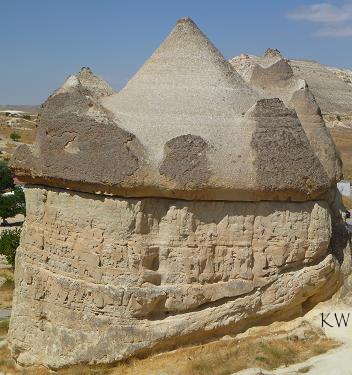
 Stacked and layered across the vast gorges and canyons of this obscure territory these strangely shaped rock formations with their pointed heads and long stems or squat bulbous domes on thick shafts of softer stone were created by seismic and volcanic activity combined with the erosion of the wind over millions of years of geologic history.

From Konya to Nevşehir, or new city, I drove along the ancient Silk Road used for centuries by the caravans that traded between the Far East and Europe.


In 1271 Marco Polo used this safe and relatively quick road to travel from Venice to Mongolia and China. Making the trip several times he accompanied traders on the route and stayed at some of the marvellous caravanserai during the long journey, traversing an Asia at peace thanks to the unification of warring tribes by the Khan dynasty.


Legend has it that Alexander the Great first established this road network that cuts through mountains and across the flat land of inner Anatolia, and as trade follows conquest the merchants soon followed his lead. The Romans, Byzantines and Seljuks all used this road, making improvements, building the inns, or caravanserai, that eventually developed into small towns to cater for travellers carrying valuable commodities such as luxurious silks from China, spices and nuts from India, and inventions that soon changed the world; along with an exchange of information and culture.


First settled in the Roman era, the town of Göreme, situated in the valley and partially carved from the rock into cave homes, has around 2,500 permanent inhabitants. It was a favourite place for ascetics during the Byzantine period when monasticism balanced the authority of the church with hermetic principles based on mystic austerity.


Though there are remains of traditional dwellings dating back to the fourth century, troglodyte villages and underground towns are more prevalent due to the ease of carving through the stone rather than shaping it for block structures. The Hittites established nearby ‘cities’ 3 millennia ago, however there is archaeological evidence of settlements in the area going back an incredible 7500 years.
 
Basil the Great, Bishop of Caesarea (Kayseri) from 370 to 379 CE, instructed anchorite communities to inhabit these ‘cells’ dug into the rock formations. Groups of hermits excavated a network of caves to serve as storage, refuges, residences, and even churches.

It was Basil who instituted reforms in the monastic life of those who had fled from society after the Romans absorbed Christianity and assimilated the clergy into the accepted fold of spiritual communities, making it a state sponsored religion.


Basil created a special class of monk; effectively under the control of the Church they guided the principles of the community of believers through abstinence and charitable works. The great cathedral in central Moscow is named after him, and looking at thess particular rock formation in the Göreme Valley of Cappadocia it is easy to see where the architects derived their inspiration for those colourful ‘onion-domes' and other subsequent basilicas.


During the iconoclast period (725-842) the decoration of these sanctuaries was held to the strict minimum of symbols, but after 842 until the end of the 12th to beginning of the 13th centuries many rupestral churches were created in these bizarre hoodoos, evidence of which can still be seen inside several of the large caves – though photographs of the paintings are not permitted.
 
A hoodoo is a tall, thin spire of rock protruding from the bottom of a barren drainage basin or region of badlands. The hoodoos consist of relatively soft rock capped by harder, less easily eroded stone that protects each column from nature’s forces. They typically form within sedimentary rock and volcanic rock formations. Nearby Erciyas volcano, a prominent and distinctly isolated peak that dominates the horizon at 3,916 metres (12,848 ft), is still active with occasional minor eruptions, and contributed to the gradual formation of this fantastic moonscape.

When hard rock, such as limestone or basalt covers a softer rock like sandstone or tuff (volcanic ash) and then becomes exposed to an erosive power, water or wind, cracks in the resistant rock allow shaping of the softer stone underneath and with small chunks of the protective layer left hoodoos can begin to form.

One can see a similar type of hoodoo in ‘the Badlands’ of South Dakota, as well as the related formations of ‘buttes’, which can also be seen in nearby Utah and Wyoming.

When erosion wears away the softer rock the stratified layers become visible, and one can see stripes of colour as the different minerals are exposed to the elements to create vibrant colourfully banded mountains, just like those in the ‘Painted Desert’ of New Mexico near the Petrified Forest and not far from that other great gorge, the Grand Canyon. In the Southwestern states, the Anaasází, or ancient Pueblo Indians, created cliff houses cut into the rock and used ladders to gain entry to provide safety from enemies.


Naturally, these similarly fashioned regions throughout the world contain geological histories that have unlocked many ancient mysteries, including providing fossil clues to the composition of the earth and the lives of dinosaurs as well as ancient communities of monks and nomadic humans; as both the American west and Cappodocia were frequented by volcanic eruptions and trapped many remains of these prehistoric creatures in the sedimentary rock.

As the effects of erosion from wind and occasional hard rain expose the alternating layers of hard and soft stone beneath the cap unusual shapes and patterns develop that are further affected by attrition, thus forming these spires and pillars, the various magical mushroom shapes and bulbous onion domes, the columns and obelisks, the thick, squat pyramids and incredible corrugated towers that reach heights of forty metres.

Nowadays, the town of Göreme is frequented by busloads of Chinese tourists (those that can get time off from their busy work schedules according to several I met over the few days I was there) and American backpacker types looking to follow the hippy trail across Europe and Asia.


While the Chinese sit comfortably on their tour buses and photograph the sights, the Americans congregate around the souvenir stands and lounge on beanbags and cushioned sofas drinking beer and discussing the merits of various places they’ve visited, eschewing the convenience of the modern for the rougher, less accessible locations as though parleying for status.


Dressed in shorts and t-shirts with slogans designed to express their uniqueness or in absurdly tie-dyed ‘hippy’ clothes that are really designer imitations of the standard wear for many of the traditional women who come to the markets from poorer towns in the mountains, staring with large sad eyes at these wealthy foreigners who seem to mock their poverty with those wooden beaded necklaces and ready cash pulled from colourfully fringed handbags.

These poeticly romantic but often overzealous travellers proclaim in their loud twanging accents over bean burgers and margaritas the wonderful harmony of their eco-friendly lifestyle and desire to commune with nature and the local customs (though the nachos at Fat Boys were a welcome treat, and the Australian owner was a genuinely nice guy).

I too have to answer for my touristic ventures and am ready to acknowledge that this global industry tears away at the fabric of these natural wonders. However, many of the people in the area have profited greatly from the influx of annual visitors to these parts, opening their traditional cave homes to tourists seeking an authentic experience, and many restaurants and shops that service the needs of the holiday-makers have done quite well from the continued trade.


Sure, the industry is overcrowded with gap-year students who think they know better than others how to participate in environmental tourism, and dominated by companies that provide packaged holidays for those too afraid to meet others unlike themselves, but overall the desire to see these marvellous sights is understandable, and with correct management everyone can benefit from measured acculturation and shared wealth of knowledge as well as assets.

I love visiting new places and seeing these unique wonders of the world, and personally waited over twenty years to visit this spectacular volcanic basin, ever since I first learned of the Christian communities that sprung up in these caves during the early monastic period. It was a trip well worth the wait, and everyone should have the opportunity to visit natural marvels such as these fairy mountains in Cappadocia to see the power of nature and the work of hands inspired by the enduring creative and resourceful human spirit.
 
*     *     *